
We believe AI liability insurance is becoming a distinct and durable insurance category. Cyber offers five lessons for building it. Our thesis is that strong capacity relationships and broker distribution will be central to winning: they support competitive coverage, access to larger clients and the scale needed to select risks well.
By Nuno Afonso, Start Ventures
In June 2017 a piece of malware called NotPetya spread out of a Ukrainian accounting package and into companies around the world. It disrupted Merck’s operations worldwide, and the company claimed roughly $1.4 billion under its property insurance.
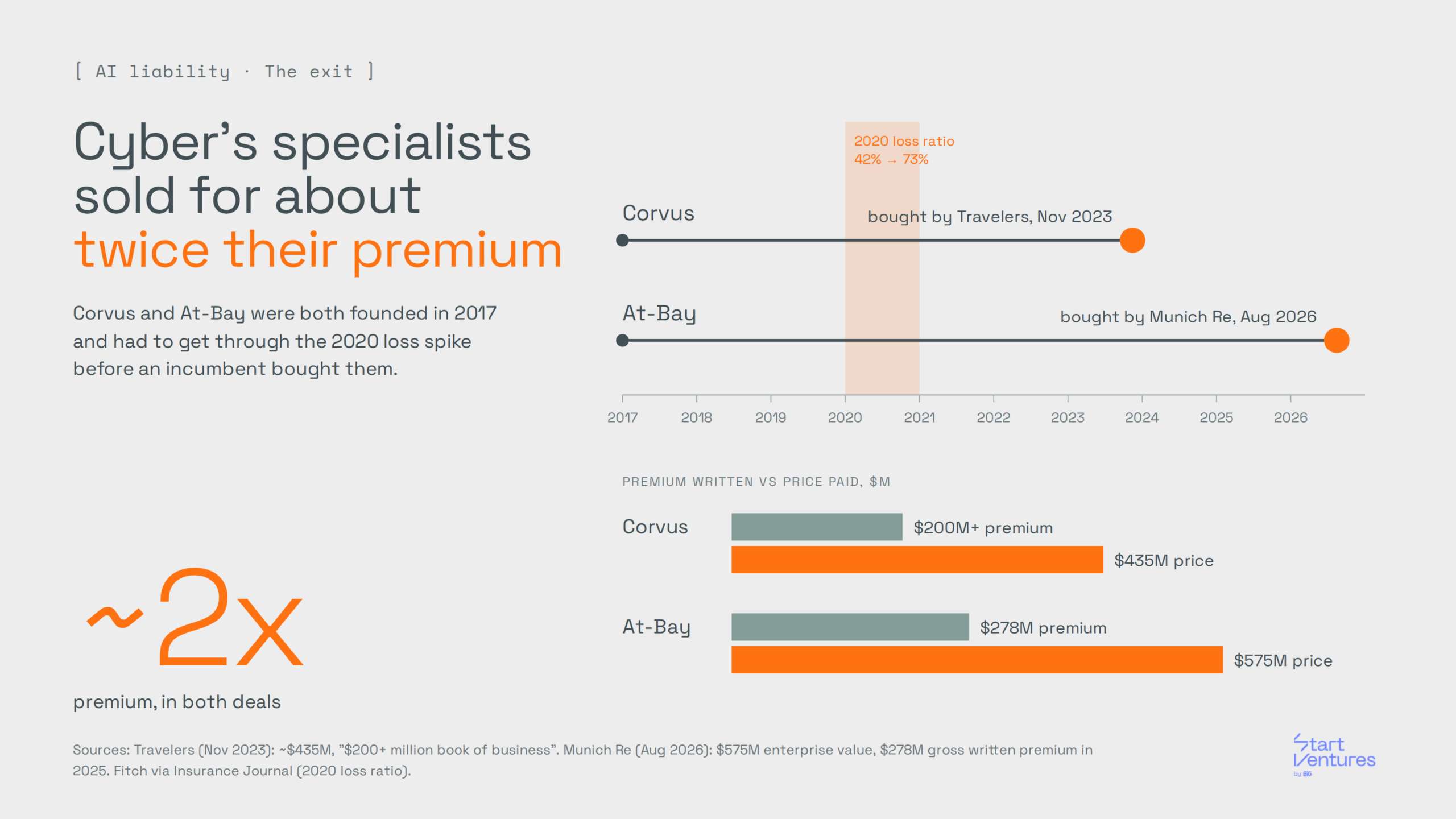
The insurers refused to pay. The policy had been written with physical damage in mind and said nothing about cyberattacks either way, so the insurers relied on the war exclusion, arguing that NotPetya had been attributed to Russia and aimed at Ukraine. Merck sued. New Jersey courts ruled against the insurers twice, and the last of them settled in January 2024, almost seven years after the attack.
The policies had been drafted before anyone imagined an attack like NotPetya. The market called that gap “silent cyber”: exposure sitting inside a policy that neither covered it nor excluded it, until a loss forced a court to decide what the words meant. AI liability is in the same position now, and the market has started calling it “silent AI”.
Silent AI
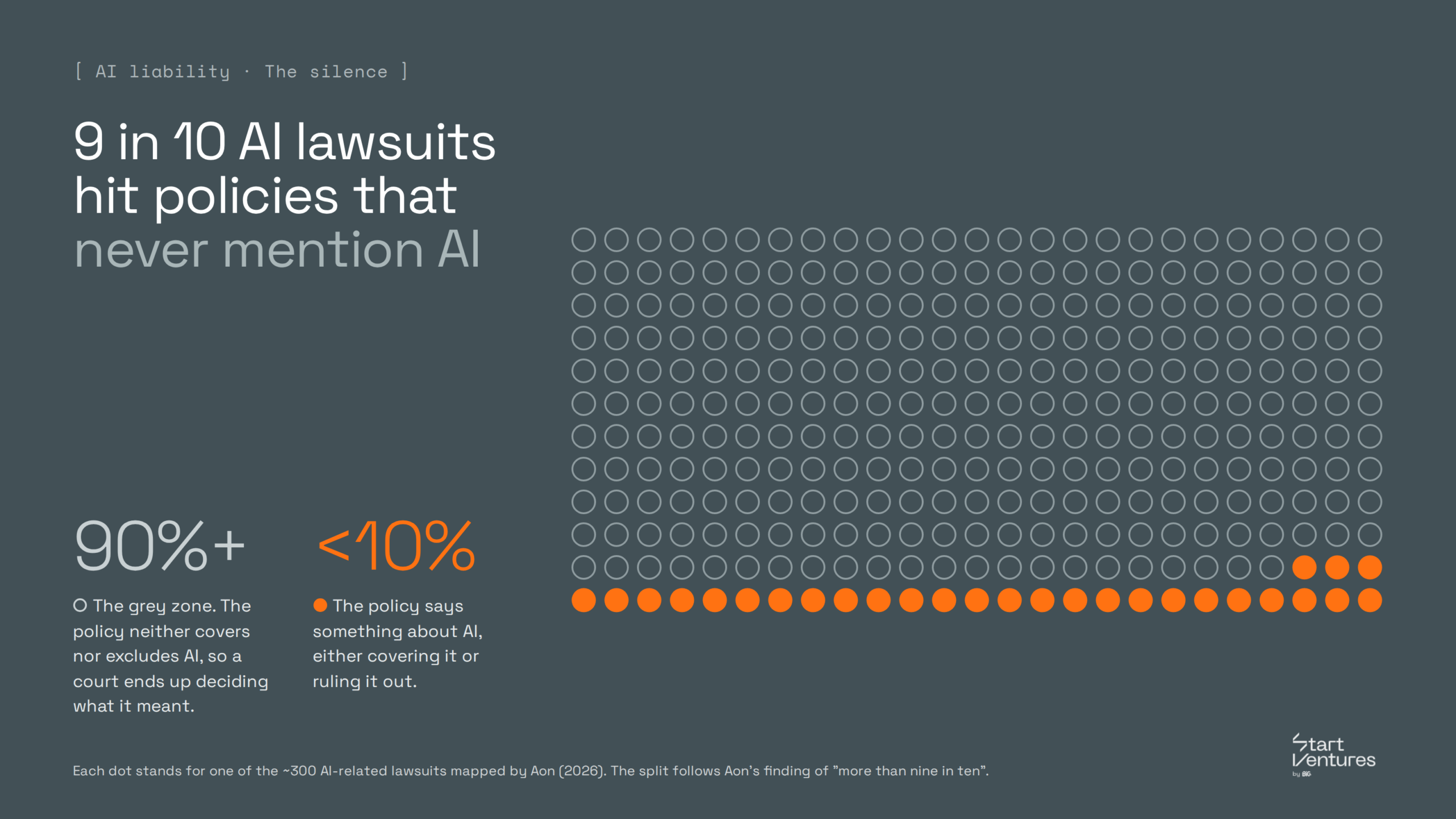
Companies now use AI to decide who gets a loan or a job interview, and to tell customers what they are owed. When one of those decisions goes wrong, the company is left with insurance policies drafted before it deployed the model. Aon mapped around 300 AI-related lawsuits and found more than nine in ten sitting in exactly this grey zone.
Courts are deciding liability faster than insurers are rewriting their policies. A Canadian tribunal held Air Canada liable for what its chatbot told a passenger about a bereavement fare. In June 2026 a US federal judge let most of the discrimination claims against Workday’s AI screening tools go forward. The month before, two German courts reached the same conclusion by different routes. The Higher Regional Court of Hamm ruled that a clinic’s chatbot is not a third party, so the medical titles it invented counted as the clinic’s own false statements, and said that careful configuration doesn’t remove the risk of hallucination. The Munich Regional Court treated Google’s AI Overviews as Google’s own speech.
Courts are converging on holding the company that deploys an AI system responsible for its output. Whether an insurer pays when that happens is, for most policies, undecided.
1. AI exclusions arrive before AI cover
After NotPetya, insurers moved first to spell out what they would not cover. In July 2019 Lloyd’s told its market that from 1 January 2020 every first-party property policy had to state explicitly whether cyber losses were covered, and later phases extended the rule to other lines. Many insurers responded by writing cyber exclusions into their property and liability policies.
Excluding is the cheaper choice for an insurer. It takes a paragraph at renewal. Covering a new risk means estimating losses with no history to go on, holding capital against them, filing new wording and getting reinsurers to back it.
AI exclusions are arriving in the same order. ISO, which writes the standard forms most US insurers use, introduced a generative-AI exclusion for general liability in January 2026. About one in ten employment practices policies already carries an AI exclusion, according to a Burns & Wilcox broker quoted in Insurance Business.
We expect exclusions to spread through directors’ and officers’, professional and employment liability over the next two to three years, until a regulator or a large market requires the kind of clarity Lloyd’s required for cyber. That creates demand. A risk manager who was only uneasy about AI now has a document from their own insurer saying the exposure isn’t covered.
2. Standalone AI insurance grows in the space exclusions leave
Cyber cover started as endorsements added to general liability and property policies. The standalone line grew once insurers began excluding cyber from those policies and the risk needed a policy of its own. Specialists such as Coalition and At-Bay built their books in that space.
AI liability cover is at that first step. CFC added explicit AI wording to seven of its existing products in June 2026, and Counterpart and Munich Re’s HSB have done something similar for smaller businesses. Only the insurer that owns the underlying policy can endorse it, so a new specialist is always selling a standalone policy of some kind.
Even so, the buyer doesn’t have to see it as something new. Cover that fills the gaps exclusions leave in a company’s existing insurance is easy to buy: the same broker places it at the same renewal, from the same budget. A policy pitched as a new category needs its own budget line, which few companies have yet; cyber had none at first and gained one as exclusions spread. The specialists we want to back start by filling those gaps. As exclusions push more AI risk out of traditional policies, the insurance budget has to grow to cover it, and that cover can grow into a full AI line with a budget of its own.
The main risk to this view is that most AI losses are liability to other people and could fit inside professional, employment and directors’ and officers’ cover, which is CFC’s argument for keeping AI inside existing products. So far the market is moving the other way: more than 60 property and casualty insurance groups had filed to adopt AI exclusions by July 2026, and Verisk is weighing a further set for agentic AI. The pace of new exclusions against new affirmative cover is the number we watch.
3. AI underwriting moves from questionnaires to evidence
The cyber insurers that grew fastest stopped relying on questionnaires. They scanned a prospect’s systems from the outside before quoting and kept scanning through the policy year. Coalition built its model around this, and when Travelers bought Corvus in 2023 it cited that capability.
Most AI underwriting still runs on forms and self-reported governance, and the specialists haven’t agreed on a method. Some test the model itself. Some price from litigation and incident data without auditing the customer. Others look at what the AI is allowed to do: whether it can move money or only draft an email, and whether a person approves its decisions. AIUC, which has raised $55 million, is pursuing a model that combines standards, audits and insurance.
We expect the winners to combine litigation and incident data with a clear understanding of what the insured’s AI is permitted to do. A well-tested model can still cause a large loss if it can approve payments without human review, while legal and claims evidence helps translate those permissions into liability exposure.
Independent audits can add useful evidence, but we do not think a single testing or certification approach has yet established itself as the winning model.
4. The first bad year decides which AI insurers survive
For cyber insurance, the first bad year was 2020. Ransomware claims surged, and the loss ratio on standalone US cyber insurance (the share of premium paid out in claims) rose to 73%, against an average of 42% over the previous five years. The average paid claim more than doubled, and insurers raised rates sharply.
AI’s first bad year will probably come from correlation. Thousands of companies build on a handful of foundation models, so one model failure, or one ruling applied across an industry, could trigger claims on many policies at once, however many sectors the book spans.
Most specialist AI insurers are managing general agents, or MGAs. An MGA designs, prices and sells the policies, but a licensed insurer lends it the right to write them and a panel of reinsurers pays most of the claims. Both relationships usually renew every year, and both partners get a quarterly report on every policy and claim. They can cut the MGA’s limits or walk away after a bad year, and also when they spot business written outside the agreed rules, pricing they no longer trust or a senior underwriter leaving. Sometimes they leave a whole class of business at once. One industry analysis calls losing a sole capacity provider “an existential crisis”, since an MGA without capacity has nothing to sell. AI makes these calls harder to get right. Ransomware claims arrived within weeks, while lawsuits take years, so an AI book written in 2026 can look clean in 2027 and go bad in 2029.
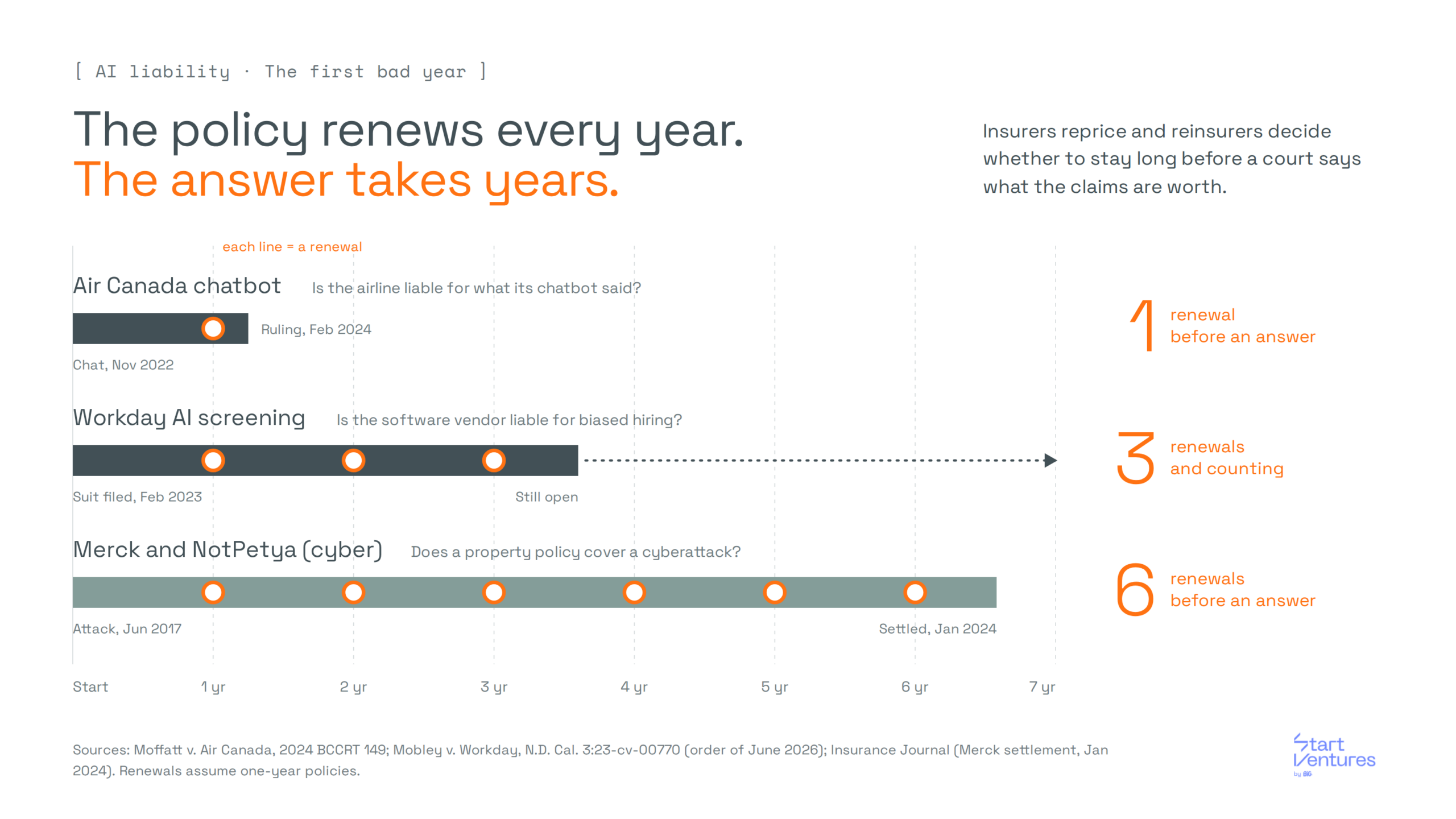
Correlation in an AI insurance book can be priced, though. What an AI is allowed to do sets how large one failure can get, and the model it runs on sets how many failures can happen together. Fifty customers whose agents approve payments unreviewed, all on the same model, are one large bet. Spread them across models, or put a person in front of each decision, and the bet shrinks. Cyber insurers handle the equivalent by tracking which cloud providers their customers depend on and capping exposure to each. AI underwriters can cap exposure per model provider, most tightly for the deployments with the most authority, and charge less for controls such as human approval above a set amount. Policy wording can also put a ceiling on a systemic event, much as Lloyd’s did for cyber when it required exclusions for state-backed cyberattacks.
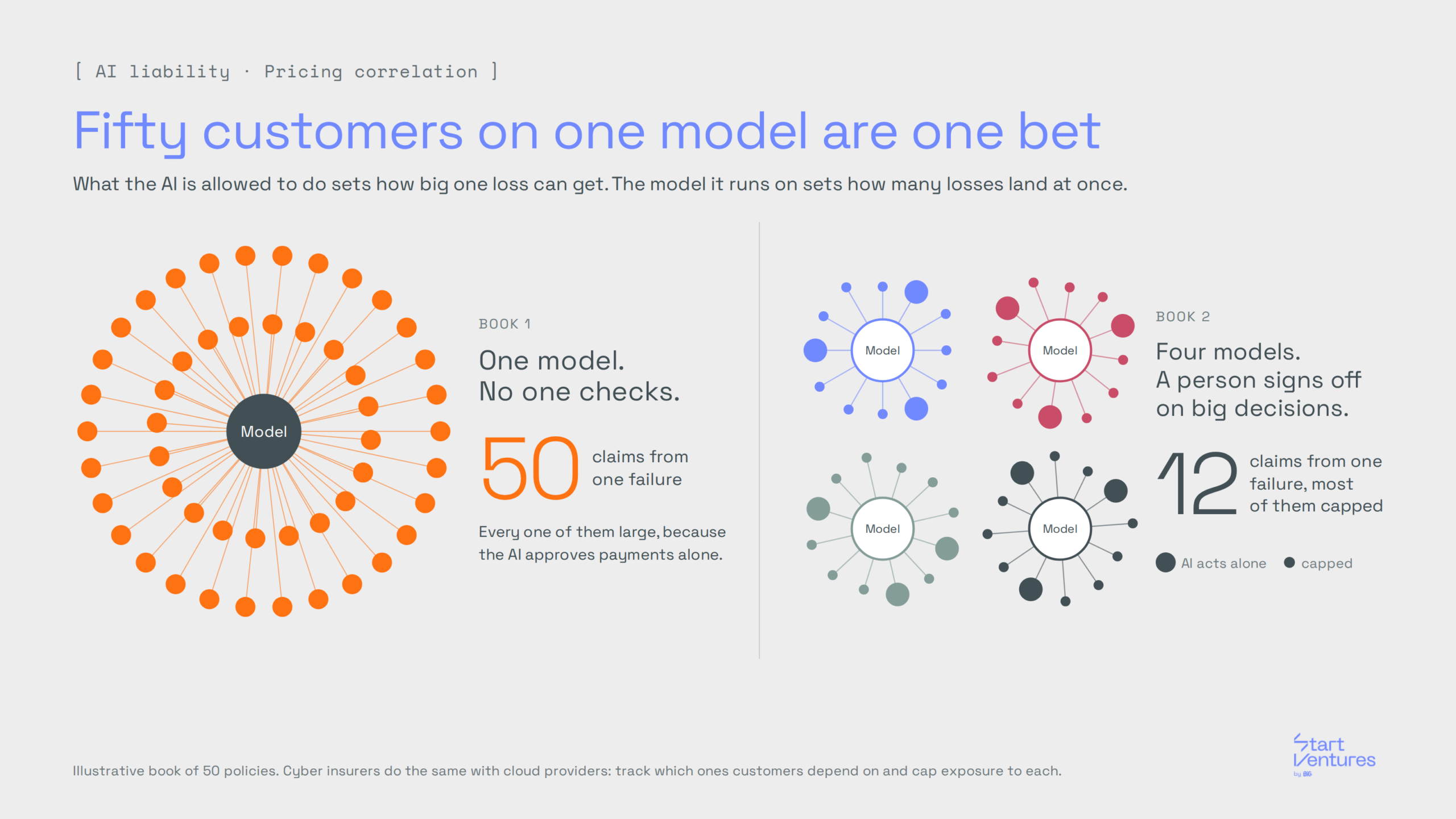
The survivors will be the MGAs that priced for correlation early and kept more than one capacity provider, and investors should note that this test comes before any exit. Corvus was bought about six years after it was founded and At-Bay about nine, and both had to get through 2020 first. An AI insurer founded in 2026 will probably face its test around the end of the decade, and a buyer will wait to see it passed. A fund backing one at seed should expect a long hold and keep reserves for at least one more round.
5. Specialist AI insurers can become valuable acquisition targets
As cyber matured, the specialists held their position. Several legacy writers shed more than half their cyber books while digital-first entrants grew at triple digits. In May 2026 Allianz handed its whole standalone cyber business to Coalition, saying cyber risk demands a dynamic, tech-forward approach.
Incumbents kept the large, complex accounts, where high limits and bespoke wording matter more than technology, and most of the successful specialists were eventually bought by incumbents. Travelers paid around $435 million for Corvus. In August 2026 Munich Re agreed to buy At-Bay for $575 million, on about $278 million of premium, or roughly twice what it wrote.
We expect AI specialists with strong underwriting, broker distribution and capacity relationships to build valuable businesses, with scope to serve larger accounts as their capacity grows. That should shape how these companies are built and funded. An MGA keeps a commission, usually in the mid-teens as a percentage of premium, and when it is sold it’s valued as an insurance business, at around twice premium. A plan that depends on a software multiple is unlikely to hold up.
Where the cyber comparison breaks
Cyber moved slowly. Standalone cyber policies go back to the late 1990s, and Lloyd’s only forced clarity in 2020. With AI, things are moving faster, but mostly in one direction: so far, many more insurers are excluding AI than covering it. Many large carriers are taking part by backing specialists with capacity instead: Hiscox, Chaucer and Axis, and Beazley have all lent their balance sheets to AI specialists this year. The window may be shorter than it was in cyber, but incumbents are as likely to be partners as competitors.
AI law is also being written as we go. Because AI losses are mostly liability to other people, the legal rules matter more than they did for cyber, and those rules shifted in two German courts and a US federal court within a few weeks of each other in May and June 2026. A risk is harder to price while its legal definition keeps moving.
An AI deployment also changes during the policy year in a way most insured risks don’t. The vendor releases a new model version, the agent gets access to another system, or a tool built for drafting emails starts approving refunds. A contract priced once a year fits that poorly, and we expect the products that last to collect evidence throughout the year.
What we look for in AI insurance startups
We believe AI liability will become a distinct insurance category. For specialist MGAs, our thesis centres on strong capacity relationships and broker distribution: together, they can support competitive terms, larger placements and enough submission flow to select risks well. Four things decide whether a company in it lasts, and they’re what we look at first.
Distribution that lets you say no
A book only tells you something once it’s big and varied enough that one bad claim, or one flaw in a model many customers share, can’t sink the year. Capacity providers stay with books like that.
Broad distribution also buys choice. An MGA that sees plenty of submissions can turn most of them down. So when we ask how many brokers have sent a founder more than one customer, what we want to know is whether the company picks its customers or takes whoever shows up.
Brokers bring access to existing commercial insurance buyers and understand where AI cover fits into their programmes. A product they can explain and place easily gives them a reason to return, creating the repeat submission flow that makes this selectivity possible.
Turning business down goes against the startup habit of growing as fast as possible. We want founders who already know that in insurance, premium written for its own sake tends to come back as losses.
Underwriting built on evidence
We want to see a company price what the AI it covers is allowed to do, and check that against something other than the customer’s own questionnaire. It should also know which model providers its book depends on, and cap how much it holds on each.
Independent assessments and controls should matter to pricing where they demonstrably reduce the insured exposure.
A capacity panel that will stay
The MGA doesn’t pay the claims. The carriers and reinsurers behind it do, and they can leave at renewal. So we look at who they are, how many there are, how they’re rated, how long they’ve committed for and on what terms they can walk away.
These relationships also shape what an MGA can sell. Trusted capacity partnerships can support higher limits, competitive pricing and broader underwriting appetite, opening access to larger placements. We see them as a commercial advantage as well as a source of resilience.
We’d rather see several well-rated reinsurers who have signed up for the class, with commission tied to results, than one famous name on a one-year deal.
Profit in the book, then in the company
The book has to make money first, with premium that covers claims and leaves a margin. An MGA whose commission rises and falls with its loss ratio has a direct reason to keep it there.
The company matters too, for a different reason: this is a long game, and a company that keeps needing new rounds will be pushed to show the growth venture investors usually want to see, and that is the kind of growth that damages an insurance book. One that can pay its own way from commission doesn’t have to make that choice. So we pay close attention to how soon, and how believably, a founder can get there.
How they get there matters as much. Losing money while hiring underwriters, an actuary and claims staff is normal. Cutting those people to reach breakeven sooner is a bad trade, because they’re the ones keeping the book profitable.
Testudo is one company we see executing well against this thesis. Its broker-first approach and capacity relationships, with a Lloyd’s panel that includes Apollo, Atrium, QBE and Hiscox, illustrate how a specialist can build distribution and the ability to insure clients together. Other players are emerging, including companies at an earlier stage of development, and we are watching how their approaches evolve.
If you’re building in AI risk or insurance and this is already how you think about it, we’d like to hear from you.
Nuno Afonso is an investor at Start Ventures, an early-stage fund backing B2B fintech and insurtech companies.